Roadmap
Development Roadmap

Development is tracked through GitLab milestones across the protocol repositories.
Completed
- Open Crown Standard specification (v2.0)
- Smart contracts on EVM and SVM (testnet)
- TypeScript SDK with browser wallet support
- Multi-chain event indexer (Go)
- Reference operator application (React, Go, PostgreSQL)
- 8-stage CI pipeline with integrated security scanning
- OCP governance process
Current Focus
- Mainnet contract deployment and verification
- Multi-chain expansion (additional EVM chains)
- Deal facilitation system (escrow and disputes)
- Post-mint onboarding flow for project creators
Next
- Creator analytics dashboard
- Health alert system (heartbeat warnings, holder changes)
- Token access tier configuration
- Crown subdomains and naming resolution
- Developer platform and plugin system
Long-Term
- Browser-native TLD for crown resolution (deferred, future ICANN round)
- Third-party operator onboarding
- Full on-chain governance (Phase 3)
- Cross-chain crown linking
Propose Changes
OpenCrown is built in the open. Anyone can propose additions to the roadmap or changes to the protocol.
Open Crown Proposals (OCPs)
The OCP process is the formal mechanism for changing the standard:
- Discuss: open an issue on the oc-standard repository
- Draft: use the OCP template
- Submit: create a merge request to oc-standard
- Review: community feedback for a minimum of 14 days
- Decision: multisig accepts, rejects, or requests changes
OCP types: Core (protocol mechanics), Interface (APIs and data formats), Meta (governance processes), Informational (guidelines and best practices).
Features and Improvements
For suggestions that don't require a formal OCP:
- oc-standard: specification questions and proposals
- oc-contracts: smart contract improvements
- oc-sdk: SDK features and bug reports
Security Issues
See the security policy for responsible disclosure guidelines and the phased bounty program.
Progressive Decentralization
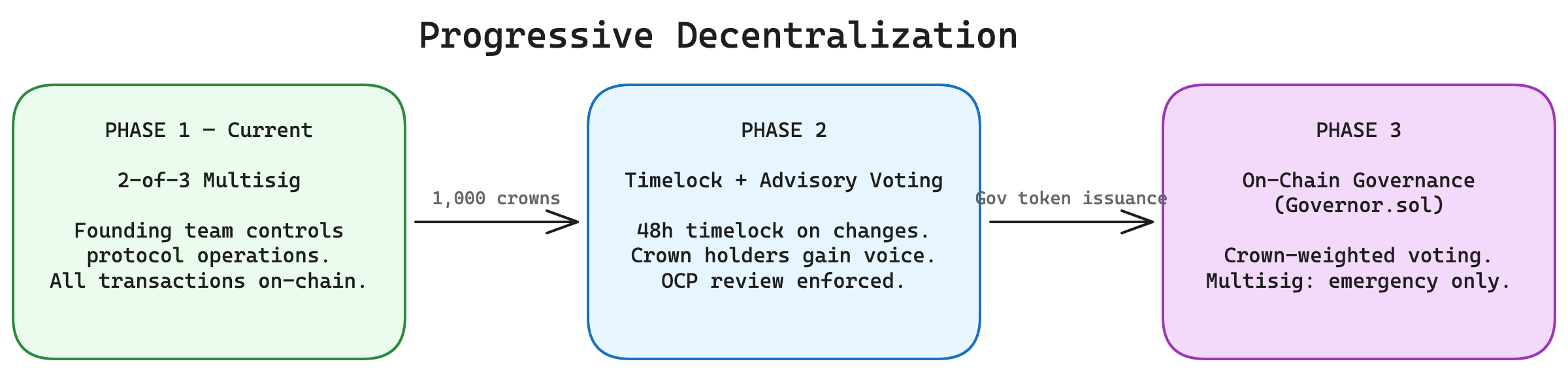
OpenCrown's governance decentralizes progressively, starting with efficient decision-making under a small multisig and expanding to full crown-holder governance as the protocol matures. Each phase is triggered by a combination of measurable on-chain milestones (crown holder count) and time anchors (months post-mainnet), so the founder-led period has a hard end date regardless of crown adoption rate.
The full governance specification, including voting thresholds, the founder veto override mechanism, and the dual-key constitutional process, lives in OCP-0002 (Crown-Weighted Governance). This page summarizes the phases.
Phase 1: Pre-Mainnet (Current)
Protocol decisions are made by a multi-signature wallet. OCPs are drafted publicly, opened for community comment, and ratified by the multisig after the comment period. No binding crown holder votes occur in this phase — the infrastructure for binding votes does not yet exist.
- Crown fee splits and deal fee caps enforced at the contract level
- All protocol changes go through the public OCP review process
- Emergency pause held by a single signer for incident response
- Founder veto is full-scope across all decision tiers
Phase 2: Bootstrap (Mainnet T+0)
Same governance model as Phase 1, anchored to mainnet launch. The Bootstrap Period treasury policy (OCP-0002 Spec 10) begins: capped, line-itemed, publicly reported reference-operator subsidy through T+24 months.
- Opinion polls open for any topic; multisig must acknowledge any poll reaching 30% participation
- Quarterly transparency reports published to IPFS within 30 days of quarter end
- Bootstrap budget: $30k Y1 / $40k Y2 working / $100k hard ceiling over 24 months
- Founder veto unchanged
Phase 2.5: Veto Narrowing
Trigger: 500 active crowns.
The founder veto scope narrows without a vote — a credibility commitment validated by the public justification log. The founder voluntarily recuses on routine grants, chain additions, app/marketplace policy, and community fund allocations under $5,000.
Veto scope retained: smart contract upgrades, treasury withdrawals above $5k, anti-squat/heartbeat integrity, OCP process, emergency pause.
Phase 3: Community Voice
Trigger: 10,000 active crowns OR T+24 months post-mainnet (whichever is first).
The T+24-month time anchor is the protocol's commitment that the founder-ratification window has a hard end date. If crown adoption is slower than projected, binding votes activate by calendar.
- Tier 1-2 binding votes activate (5% / 8% quorum, 50% / 60% approval, 7 / 14-day timelock)
- Founder veto remains scoped per Phase 2.5 but is overridable by 10% crown holder vote at >60% approval
- VoteAggregator deploys on all supported chains; cross-chain aggregation via the Coordinator
- Bootstrap Period treasury subsidy sunsets at this trigger if it fires on the T+24mo anchor
Phase 4: Shared Governance
Trigger: 100,000 active crowns.
- Tier 3 binding votes activate (12% quorum, >66.7% approval, 30-day timelock); founder veto override at 18% / >66%
- Crown holder reactive veto live (20% petition, >50% to overturn)
- Founder veto narrows further to emergency pause and contract upgrade only
- Mandatory annual reviews of fees, heartbeat weights, multisig composition, and treasury allocation
Phase 5: Full DAO
Trigger: 1,000,000 active crowns OR December 31, 2030 (whichever is first).
- Tier 4 dual-key constitutional path activates (community 15% / >66.7% AND multisig consent)
- Multisig migrates to an elected security council; the founder transitions to chair role with convening authority only
- December 31, 2030 hard backstop: Phase 5 activates regardless of crown count
Design Principles
Crowns survive without any operator. Crown ownership is on-chain, verification proofs are on-chain events, and metadata is on IPFS. Direct contract interaction is always available via the SDK and CLI, so if every operator disappeared tomorrow, crowns would still exist and remain resolvable.
Exit capability builds trust. Users can leave at any time — exporting their data, interacting directly with contracts, or switching operators — because the architecture itself is permissionless.
The DAO runs near break-even. Roughly 20% of crown claim and deal fees fund protocol development; the design target is sustainability rather than profit. During the Bootstrap Period the treasury subsidizes public-goods infrastructure (RPC, indexer, audits, SDK, docs) on a capped, time-bounded, line-itemed budget. After Phase 3, all protocol infrastructure funding flows through open RFP/grant processes.